Money-focused crypto projects tend to fall into one of three categories. Extractive ones like pump.fun are almost always moving resources toward a small number of people, usually from latecomers who don’t know better to insiders who prey on them. Neutral ones like Uniswap are simply infrastructure, they can be used in extractive ways, but can just as easily be used to help. There’s also a third category, that I think of as prosocial projects, ones that are actively trying to do something useful for people outside the system.
There’s been a lot written on the first category, less on the second, and almost nothing on the third. I believe that’s in part because the projects that fit into this category aren’t focused on speculation, which tends to drive attention in the crypto space. That speculation is driven by the desire for asymmetric upside, which can be tempting for anyone, but especially for people who don’t have resources to work with in the first place.
A lot of people play the lottery. The standard advice is to put that money in a savings account instead, but that advice doesn’t work in reality. A high-yield account right now gets you around 3 to 4% in yield. Someone spending $10 a week on lottery tickets isn’t going to be moved by the math that says if they save for 10 weeks they’ll earn $3 more a year. The number is too small and the psychological appeal isn’t there. The lottery is appealing because it’s one of the only ways someone can realistically see themselves getting an outsized outcome from where they are.
Two examples of projects that I think fit into the prosocial category are PoolTogether and HaloFi (formerly known as GoodGhosting). Both took direct aim at this problem, in different ways.
PoolTogether was a project designed around the idea of a lossless lottery. Participants deposit money into the protocol in exchange for raffle tickets. The lottery still happens, but the pot that the rewards are paid out of comes from the collective interest on the entire pool of money deposited into the protocol. At a large enough size, the interest that communal pot generates is significant, and you still have a chance at winning a portion of it. Meanwhile, your tickets aren’t used up week to week, and your money can still be removed from the principal at any time by swapping your raffle tickets back, so you can’t ever lose the money you put in.
PoolTogether was doing this, and had real momentum. At its peak, it had just over $230 million in deposits generating interest that was given out in weekly lotteries. There were real success stories too, with one user who deposited $74 winning just under $40,000 on their deposit, which they could still get back afterwards.
HaloFi took a different approach. Instead of a lottery, it tried to focus on building steady savings habits by making saving competitive. Challenges would be set with savings goals and time periods. For instance, one might be to save $100 over 10 weeks, with weekly deposits of $10. Similar to PoolTogether, any money deposited would go into a communal pool used to generate yield. At the end of a challenge period, if you kept up with your deposits, you got your entire deposit back, along with a proportional share of the yield generated. If you didn’t manage to make each payment, you still got your entire deposit back, but the yield that you would be entitled to is instead distributed evenly to those who did complete the challenge. You could also withdraw your money at any point before the challenge was over. The mechanism worked, people didn’t want to give up their yield, and kept coming back to make their deposits. There were success stories here too, with more than four million dollars being saved.
Unfortunately, neither of these stories end well. PoolTogether was taken to court by a man named Joseph Kent, who alleged they were running an illegal lottery that was hurting its users. His standing for the case was that he deposited $10 in the protocol, and transaction fees during the deposit had already outpaced any expected returns. What wasn’t mentioned was that he intentionally used the least efficient method of depositing his money, choosing to pay the maximum amount he could. While PoolTogether offered ways to deposit into the protocol for fractions of a cent, Joseph simply did not use them. The case was eventually dismissed, but it took community fundraising to pay the fees for years of a protracted legal battle, from 2021 till its dismissal in 2023. By this time, the protocol had lost its momentum, and along with the volatility in the overall market, it faded from prominence.
Something worth noting here is that Joseph Kent is not your average user. He was the technology team lead for Elizabeth Warren’s presidential campaign in 2020, and Warren has made opposing crypto a consistent part of her political platform. I can’t say for certain that this was coordinated, but the people most motivated to see this project fail had direct ties to the lawsuit that did it.
HaloFi’s end was quieter. The mechanism worked, and the users were there, but there was no viable path to funding the business itself. Any fee they could take from the generated yield was too small to matter operationally, and would have come directly out of what users earned. In late 2024, they announced they couldn’t secure another funding round and were shutting down. This brings us back to the problem with a space so heavily driven by speculation. It isn’t just everyday people chasing asymmetric upside, venture capitalists and investors are looking for it too. A prosocial project designed to slowly and safely build wealth for its users doesn’t offer a 100x return to early investors, which makes raising money to survive as a business in the space incredibly difficult.
These were two projects trying to do something useful for people outside of the system. HaloFi is gone, and while PoolTogether technically survived its legal battle, it exists as a fraction of its former self. But the underlying mechanisms worked. A $74 deposit winning $40,000 and four million dollars saved are real-world benefits. If there was more interest from investors and less hostility from regulators, there’s no reason ecosystems like this couldn’t thrive.
If you try enough free to play games, you eventually realize that most monetization models mean that if you want to play a game without paying, you will need to be extremely careful with your in game resources. This is often most true at the beginning of games, where you are given some amount of things for free to bring you in just far enough that you get into the main gameplay loop and are then left at a point where you are encouraged to pay into the game to progress further. Wasting these free resources puts you far behind where you can be, so when I start playing a game, I try to look for some information beforehand.
When I started Warframe, I found 13 years worth of beginner’s information, a lot of which was very helpful, but it was all spread out across many different videos and comments, many of which weren’t relevant anymore. This is my attempt at trying to organize what I would have liked to know before starting and putting it all in one place. This is meant to only cover the very early game, just enough so that people can get their feet under them without sabotaging themselves.
What is Warframe?
At its core, Warframe is a looter shooter that builds up into a power fantasy game. You get equipment, make it stronger, and watch yourself go through enemies faster each time you do a mission. Warframe has also been around for 13 years though, and they’ve experimented a lot during that time. If you want, you can ignore the main gameplay loop and ride around on a hoverboard doing tricks to earn reputation with the vent kids as soon as you unlock it a few hours in. The amount of systems in the game do mean that they’re not all very fleshed out, as it seems like Digital Extremes is the kind of studio that is willing to try something, and if it doesn’t work out just move on and try the next thing, but they’re all worth giving a shot at least. The amount of content also means this game is a marathon. Don’t burn yourself out in the first few days.
Is Warframe pay to win?
Not really, it’s more pay to skip time or content. Most everything in the game is obtainable through normal gameplay, and there is also player-to-player trading so you can get the premium currency without paying real money.
Does Warframe have servers?
Lobbies are peer to peer connections. Warframe is also cross platform. The game is always online. Missions can be done solo, with open lobbies, or with parties you assemble beforehand. Open lobbies will often have higher level players join to help, but that often means they finish the level before you even get started. If you want to play through something slowly, be sure to set it to solo. You can always exit and switch if things aren’t going well. If the host of a lobby leaves, the game will make another player present become the host, and might reload for a few moments.
Movement
One of the things that make this game unique is that you can go very fast if you want to. The tutorial will teach you specifics but once you get used to things you get into a rhythm and will almost never be just running somewhere. Specifically, bullet jumping and aim gliding will help you keep up with other players while you work through maps.
Warframes
Warframes are like champions or classes in other games. They each play differently but fit into general archetypes like tank, support, and dps. They each have a passive ability and 4 activated abilities. These can be altered slightly later in the game, but it’s not something you need to worry about at the start, you’ll know when you get there. As of writing, there are 63 warframes, each with their own theme. Until you get to the endgame they’re all viable, so prioritize getting the ones that seem interesting and fun to you. You can check out the full list here.
Get used to that wiki, you’ll probably be needing it a lot. If you don’t know what’s going on, just look it up.
At the start of the game, you get a choice between Volt, Mag, and Excalibur. As mentioned, they’re all fine options, but if you really want to squeeze as much value as you can out of the beginning, I believe Volt performs the best as you transition into endgame content. Whichever you choose, you can get the other two fairly easily. Mag and Excalibur have parts that drop from bosses, and Volt can be purchased from a shop when you join a clan, this game’s version of guilds. You will end up with many warframes, so don’t spend too much time thinking about this, you might find your favorite is something completely different.
MagExcaliburVolt
Basic Equipment
You get a primary weapon, a secondary weapon, a melee weapon, and a utility tool/dagger.
You also get a companion slot, and a weapon for your companion.
You will unlock more types of equipment, like a space suit and space ship, but that’s out of scope for this guide.
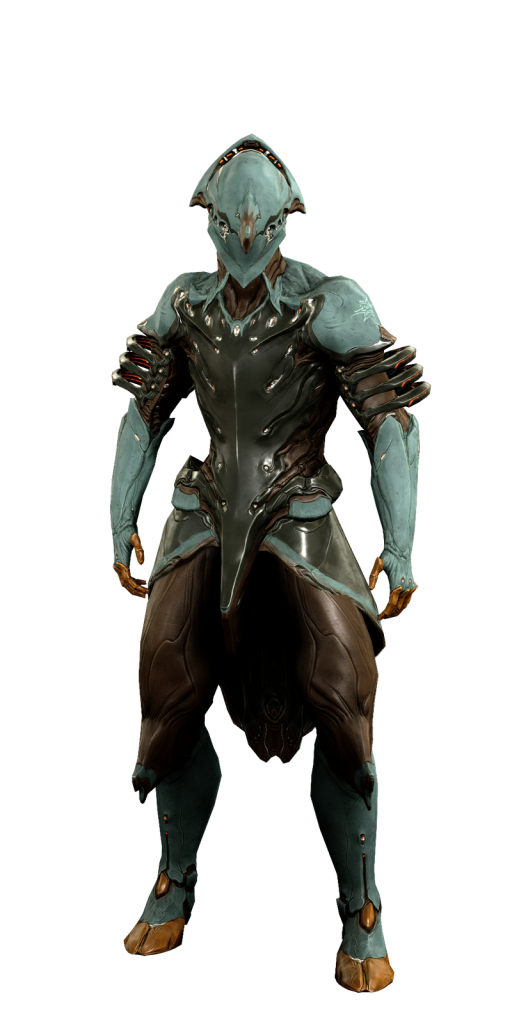
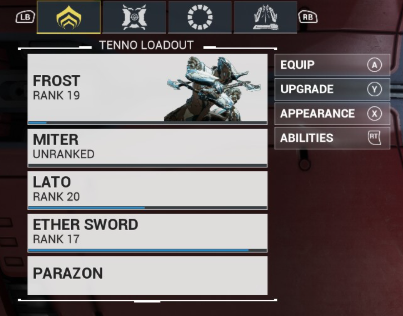
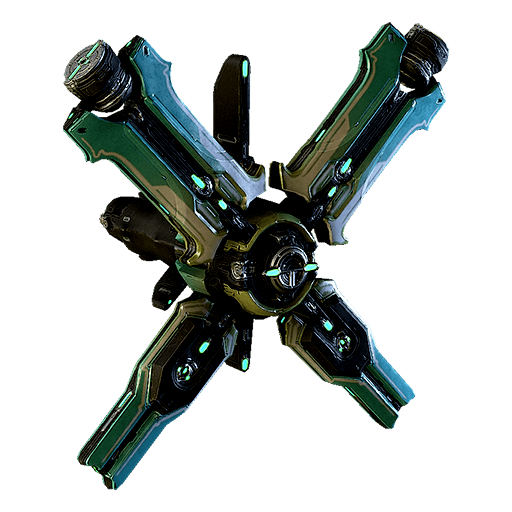
The Warframe is Frost, the primary is Miter, the secondary is Lato, the melee is the Ether Sword, and the utility dagger is the parazon.
Companions
Companions can be robots or animals. You get a robot for free pretty early, and there’s also a relatively early quest to get your first pet. They can be useful for a lot of things, but in the early game their biggest benefit is that they can pick up items for you.
A KubrowTaxon
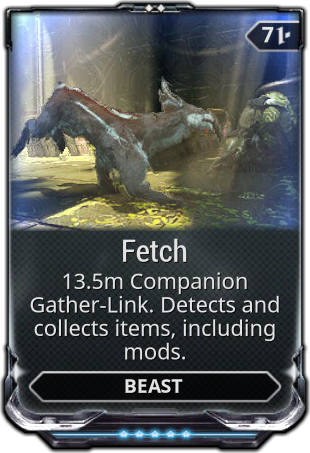
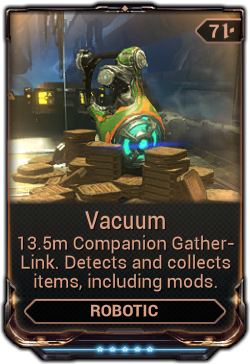
Be sure to level up the mod that extends the range they do this in (Vacuum for robots, Fetch for animals), otherwise you will have to walk over each thing you want to pick up, and that gets very tedious quickly.
Star Chart and Junctions
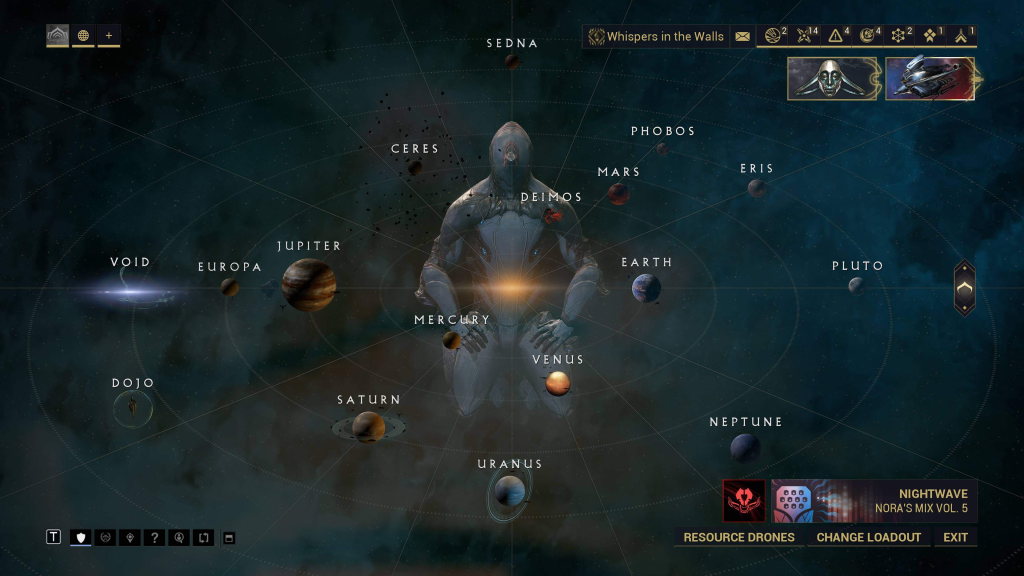
The star chart is the map of the universe. Each planet has nodes on it that represent missions on them. To make your way from planet to planet, you need to complete missions to follow a path between Junctions. The Junctions will also have some requirements that you will need to fulfill. Once you have, you have a mini boss fight and then get access to the next planet. The junctions also usually give you some rewards.
Mastery rank
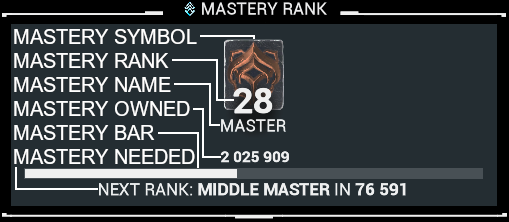
This is the closest thing to an account level. Every time you use a thing you can equip, you gain some affinity with it until it gets to level 30, with some rare exceptions going up to 40. For each level you get on the item, you get some mastery rank points. Once you get enough points, you do a trial to rank up to the next mastery rank. Mastery rank unlocks more weapons until you get to 17, after which you mostly gain quality of life improvements. Your account mastery rank goes up till 30, after which there are 5 ‘legend’ ranks.
One of the more basic loops in the game is getting a new item and ranking it up to 30. During the process, if you decide you like it, you can keep it and invest more resources into it. If you don’t, you can sell it once you’ve gotten all the mastery points out of it. Variations on a weapon count separately in terms of accumulating mastery points. For example, the MK1-Braton, the normal Braton, and the Braton Prime all have their own affinity and can each give you a weapon’s worth of mastery points.
(Quest) Items and Crafting
Do NOT sell any weapons or warframes that you get from quests. Some of the stuff you get for free early can carry you pretty far and it’s a pain to get back if you lose it. There are some exceptions, but this is a good rule for the most part.
Don’t sell anything until you max level it and get all the mastery points you can from it. You’re gonna hate some weapons and frames but it’ll go fast once you figure things out.
Some weapons are needed to craft another weapon so check the wiki to see if you should keep it until you’re ready to build the new weapon.
Managing your weapon slots is one of the pain points in the game because they want you to spend real money on getting more. You’ll get some for free but you still need to think a second to make sure you can hold everything you want to or you might have to sell something you don’t want to.
Your crafting area (Foundry) can act like a pseudo storage. Once you start creating an item, it builds automatically, and you can build multiple things at once. When items finish, you can leave them there, not collecting them until you have the extra space you need. The first items you can craft don’t take too long, but soon you will have minimums of 12 hour crafting times, making it important that you fall into a rhythm where you pretty much always have something crafting.
Mods
Warframes and weapons and companions all come with their own stat lines and effects but they also come with ‘capacity’ that you can spend on mods. This isn’t permanent, but if you fill your capacity for something, you’ll have to either find a way to expand it, or take a mod out to install another one. Mods can do a lot of different things, from basic +% health for your Warframe or +% damage on rifles, to ultra specific mods that only work one one weapon and have challenges you need to do to even reveal what the bonuses are. There are a lot of different kinds of mods, you will constantly be finding new ones and copies of ones you already have from all sorts of sources, including enemy loot, mission rewards, and shops.
Mods can be powered up but each level makes them take more capacity and costs more to rank up each time. You don’t need to max rank everything at the beginning but it’s (usually) better to have a couple mods ranked up than a bunch at rank 1.
Mods have a symbol on them, called polarities. Mod slots in your equipment also sometimes have a symbol. If you match the symbols the mod capacity cost is cut in half. Endgame builds have setups where every slot has a symbol with a mod that matches to maximize what you can get out of the space but that’s far away.
If you have duplicate mods, dissolve them for endo. You should almost never sell them for credits.
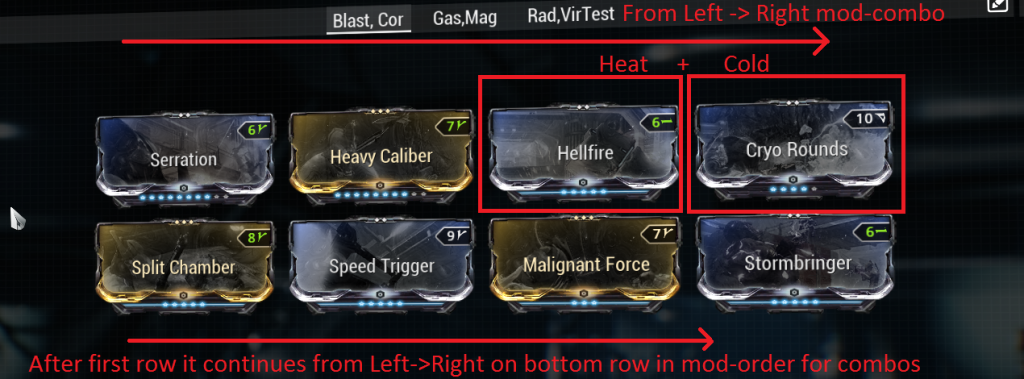
Mods apply from left to right, first the top, then the bottom. This matters if you’re trying to get specific combinations of elements on a weapon,
Potatoes and puzzle pieces
One way to increase capacity on an item is using something called an orokin catalyst on weapons, or orokin reactor on frames. Each doubles the capacity of the item they’re installed in. Once it is installed, they cannot be removed. Each item can only have one put into it. People sometimes call these potatoes.
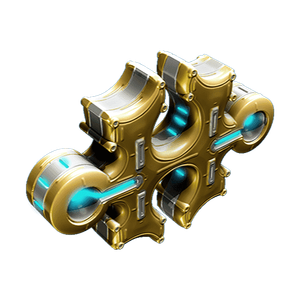
Forma are things that look like puzzle pieces. If a piece of equipment is at rank 30, you can use a forma to reset its rank back to 0, while being allowed to add a polarity of your choice to a mod slot on the item. Leveling it back up doesn’t give you any more mastery points, but you can forma it again if you get it back to 30.
Most of the free weapons you get from various sources will come with a weapon slot and a catalyst already installed. This is another reason not to sell quest items.
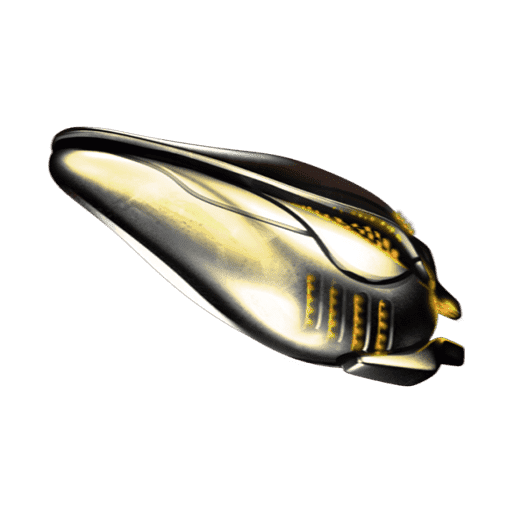
Orokin ReactorFormaOrokin Catalyst
Status Conditions
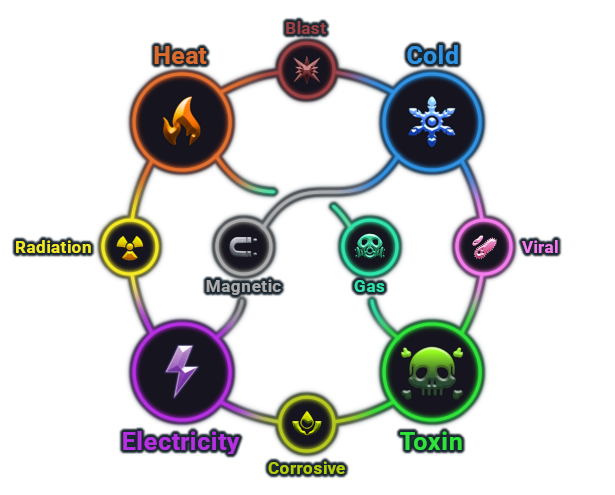
One of the types of mods you will get are ones that add specific kinds of damage to your stats. These can be broken up into elemental statuses, and physical statuses. The physical statuses are puncture, slash, and impact. The elemental statuses are heat, cold, electricity, and toxin. The four elemental statuses can also be combined into pairs to create compound status effects. There’s a lot of math that I won’t get into here, but this is a quick rundown of what each status does. A generic combination that works well is viral and heat, but each status does more damage to certain kinds of enemies, so if you’re having trouble with something, check the recommended damage types.
Heat: Deals damage over time and strips armor.
Cold: Reduces enemy movement speed, fire rate, and attack speed. Enemy receives increased critical multiplier damage. With enough stacks, the enemy is frozen solid.
Electricity: Deals damage over time in an area of effect, and stuns enemies.
Toxin: Deals damage over time and bypasses shields.
Blast (Heat + Cold): Deals damage to a target after a delay. If enough blast is applied, or the target dies, the target will explode and do damage to nearby enemies.
Gas (Heat + Toxin): Damage over time in an area of effect.
Magnetic (Cold + Electricity): Amplifies damage done to enemy shields. When an enemy’s shield is broken, also apply bonus Electric damage.
Radiation (Heat + Electricity): Enemies attack and are attacked by other nearby enemies.
Viral (Cold + Toxin): Amplifies damage done to the enemy’s health.
The three physical status types are:
Impact: Causes targets to flinch and staggers movement, allows for mercy kills at higher health thresholds.
Puncture: Reduces any damage dealt by enemies. Enemies receive an increased chance to take crits from your weapons.
Slash: Deals damage over time. This damage bypasses armor.
Quick Framework for Weapon Modding
+% flat damage is always good, so is multishot. After that, look at the weapon’s base stats. If it has 15% or better base critical chance, focus on mods that will take advantage of that, like increased crit chance, and crit damage. Same thing for status chance, if it has 15% or more, focus on that. There are some guns that have both, or neither. It’ll be up to you to figure out what works best with that specific weapon and any unique characteristics it has.
Currencies
There are three major currencies to think about at the beginning, credits, endo, and platinum. Credits are your basic currency, like generic gold in most games. It drops from pretty much everything and you’ll get a good amount just passively playing. Endo is a bit more rare, but still drops from enemies and is used as mission rewards. You need credits and endo to rank up your mods. Platinum is the premium paid currency. You can spend real money on it if you want to, but you can also sell items to other players for platinum to get it instead.
You get 50 free platinum when you start the game. This platinum cannot be used for player to player trading. Use this to buy 1 warframe slot, and 2 bundles of weapon slots (4 total) from the market. It should cost 44 platinum, leaving 6 left over.
The only thing you really need to spend platinum on are warframe and weapon slots. The rest is either cosmetic or just a way to skip over grinding something.
EndoPlatinumCredits
The Market
When you open the market for the first time, it can look like everything can only be bought in platinum. To see what you don’t need platinum for, click the 3 buttons in the top left to hide items you already own, items you’ve already mastered, and items that don’t have a blueprint. This should leave only items that have a blueprint that can be purchased with credits.
Primes
A lot, but not all, items have a ‘Prime’ variation. Primes are strictly better than their base versions. If you have a choice of putting resources into a base variant of something or a prime variant, you should choose the prime.
Not all primes are available at all times. As time passes, primes get ‘vaulted’ as new ones become available. To get vaulted primes, you need to either buy them from people who were around when they were available, or wait till they come back into rotation in a specialty store.
Void Relics
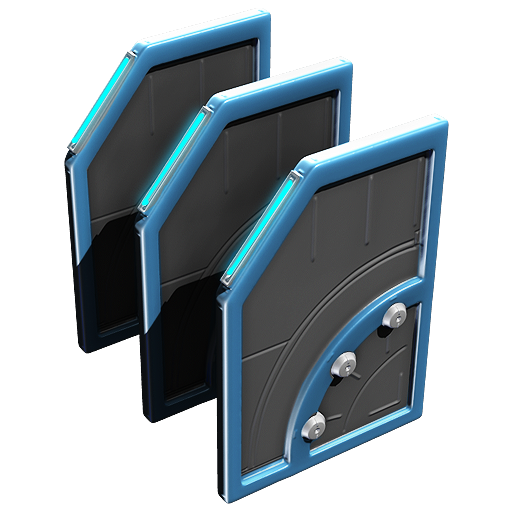
These are how you get prime parts to build prime items. They’re kind of like lootboxes but you get a lot of them just by playing and they don’t need anything special to open them. There are different tiers of void relics. To open one, you do a void mission that matches the tier of the relic you’re trying to open. If you complete the mission successfully, your relic opens to give you an item. If possible, you should always do these in groups of 4 (the maximum party size). This allows everyone in the party to pick any of the 4 items that are revealed, including multiple people picking one item. By doing the mission with more people, the chances of getting a rare drop go up. During these missions, you will also pick up items called void traces. Void traces can be applied to a relic before starting a mission, and doing so will increase the odds of getting a rare item.
A Lith Void Relic
Nightwave
This is Warframe’s free battle pass. It doesn’t last for any set amount of time, the developers give a 2 week warning heads up when they end each season.
You do challenges to get experience and level up the pass. This is important for free to play players to do since the pass gives you some valuable things like a warframe slot and a weapon slot. The pass also awards you credits you can spend in a shop that has a weekly rotating inventory. This is another way to get orokin catalysts and reactors, but the most important thing you can purchase is an item called nitain extract. This is a required ingredient for many pieces of equipment, and the odds you gather enough naturally through the few other methods are near zero.
Clans
Clans are this game’s version of guilds. It’s important to join a clan because they hold access to different labs, in which you can buy unique weapons and warframes for credits. Some of them take themselves very seriously, but there’s also a lot that require nothing from you.
Relays
Outside of missions and clan dojos, this is where people can gather and interact. If you ever need to walk away from your computer for a few minutes, be sure to go to the relay on Earth first. Once a player reaches mastery rank 30, they can use a blessing on a relay, giving everyone present boosted rates for things like affinity gain, credit drops, resource groups, and some other stats. This happens pretty often, there’s a decent chance you’ll come back to a booster applied on you.
First Steps
Play the game how you want, this is just a suggestion on what to do first if you don’t have any other ideas.
Before you do anything, check your settings, there are a few things I changed. Your alternate fire/heavy attack keybind defaults to your scroll wheel, which isn’t very convenient to click. There’s a setting that makes semi-auto weapons work like full-auto ones. You can disable screen shake. You can set enemy and ally highlights if you can’t see what’s going on very well. You can display your ping and FPS. The rest is going to depend on personal preference and playstyles.
First do the tutorial and the quest The Teacher. Get used to moving around.
In the early game, breaking containers and opening lockers is a decent way to get some materials and credits quickly. Sometimes these will drop something called ayatan stars. Pick them up and hold on to them, they’ll be useful as a source of Endo later.
Work your way to Venus through the nodes on Earth and the Junction. You’ll be completing Junctions to unlock each planet.
Make sure you’re remembering to mod your equipment and rank things up. Aura mods like Dreamer’s Bond increase your warframes capacity, letting you add even more mods.
Kill the boss on Venus till you have the parts to craft your first new frame, Rhino. Rhino is very good, and nearly impossible to die with. If you’re ever struggling with something, Rhino is a good fallback (or main).
Make your way to Mars. When you get there, the path will split into three directions. Deimos continues the main story, while the other two let you explore more. It’s up to you to decide what to do from here. If you’re ever lost, the top right has a suggestion box on what you can do next.
The following are the official bylaws I helped design and draft for MetricsDAO in 2023. They serve as a practical example of how to legally bind a Delaware nonstock corporation to the onchain and offchain governance decisions of a decentralized community (using tools like Snapshot, Discourse, and digital badges).
MetricsDAO Assoc. (the “DAO”) is a Delaware nonstock corporation organized to cultivate an inclusive data services marketplace and vibrant community ecosystem. We strive to democratize on-chain and off-chain participation, driving organizations’ digital growth. By intertwining blockchain technology and data services, we aim to foster a collaborative environment where analysts and organizations can connect, share insights, and catalyze the transformative power of the space (the “Mission”). These Bylaws set forth to govern the internal matters of the DAO.
ARTICLE I
MEMBERS
Voters. The DAO has one class of “Members,” called the “Voters.” Voter-status and other roles discussed below are designated by digital, non-transferable “badges” using a technology solution selected by the DAO from time to time (“Badge(s)”). A person may only hold one (1) Badge of any Badge class at any time. A Member may hold more than one Badge from different Badge classes.
Any person may become a “Voter” by receiving a Core Contributor Badge or Steward Badge (each, a “Voter Badge”), as each is defined below.
Voters work towards furthering the Mission and are active members in the DAO. They may act in any number of roles such as analysts, educators, governance researchers, treasury managers, moderators, content creators and community stewards, as well as being active participants in the governance system. Voters publish proposals, comment on RFCs, and participate in polls, so that governance is the most reflective of the will of the community at any time. There are two subclasses of Voters:
Core Contributors. Persons who participate in the day-to-day operations of the DAO including in areas like business development, marketing, treasury management, among other things, become “Core Contributors” by receiving a Core Contributor Badge.
Stewards. Persons who provide value to the larger ecosystem (without being involved in the day-to-day operations), become “Stewards” by receiving a Steward Badge.
A membership in the DAO is not transferable. A Member may terminate their membership in the DAO by requesting the Lead Badger (as defined below) to revoke all or some of their Badges.
ARTICLE II
BOARD
The DAO is governed by the Voters. However, to the minimum extent required by applicable law and as set forth below, certain matters of the DAO require participation from a Board of Directors elected by the Voters (the “Board”). The initial size of the Board shall be seven (7) persons (each, a “Director”).
An elected Director is given a Board Badge. A Director may resign by sending a conspicuous written notice in the designated Discord channel typically used for important community notices (the “Resignation Notice”). A Director’s resignation is effective once a replacement Director has been appointed, unless the resigning Director clearly states their intent to resign effective immediately in the Resignation Notice.
ARTICLE III
OFFICERS
The DAO is governed by the Voters. However, to the minimum extent required by applicable law and as set forth below, certain administrative tasks will be assigned to one or more persons designated by the Board, after a guiding vote by the Voters, who are then given an Officer Badge (as defined below) (each, an “Officer”). An Officer may resign by requesting a Lead Badger to revoke the applicable Badge.
An Officer shall have the power to execute all contracts, agreements, and other obligations of the DAO that are authorized by the Voters or the Board. However, an Officer shall be empowered to execute and handle ministerial, administrative tasks on behalf of the DAO without a separate vote by Voters or the Board, including filing tax returns and annual state reports, KYC processes for receiving airdrops, among other similar administrative things that do not affect the success of the DAO.
ARTICLE IV
LEAD BADGERS
The DAO is governed by the Voters. However, to guarantee smooth operations of the DAO, the Voters will elect one or more persons (each, a “Lead Badger”), who are then given a Lead Badge, to manage certain administrative and other responsibilities, including:
Checking if METIPs (as defined below) are correctly formatted, submitted in the right forum category and are well-shaped, understandable and not in violation of the MetricsDAO Code of Conduct or Mission;
Creating and providing Voter, Board and Officer Badges;
Revoking Voter, Board or Officer Badges in the event of one of these roles leaving or in the case of a clear violation of the Code of Conduct, or if otherwise instructed by valid governance output; and
Answering questions about governance processes and aiding proposal authors along the lifecycle of the proposal to make governance contributions easier.
A Lead Badger can be terminated at any time via an Emergency Poll (as defined below) should they behave in a manner that is contrary to the Code of Conduct. If a proposal to replace a Lead Badger is supported by at least seven Voters, as indicated by explicit consent via a reply to the proposal post, the implicated Lead Badgers cannot revoke any Voter Badges for the duration of the poll.
ARTICLE V
VOTING
Section 1. Proposal.
A Voter (the “Author”) may submit a formal proposal (“METIP”) for review and consideration by entering it into the Governance category in Discourse. Voters should publish new METIPs ahead of weekends or holidays to ensure maximum participation by the community and respect off-time and family obligations.
Section 2. Request for Comments.
A proposed METIP has a three day (72 hours) feedback period (“RFC Period”).
The RFC Period shall be four days (96 hours) for any METIP involving:
Approval of an annual budget;
Changes to the Certificate of Incorporation, Code of Conduct or these bylaws; or
Any other matter that needs a Board approval under applicable law.
(each, a “Material Matter”).
The RFC Period shall be one day (24 hours) for a METIP that the Author clearly marks in the heading as an “Emergency METIP.”
During the RFC Period, the Author may amend the METIP based on feedback from other Voters.
Section 3. Frozen Period.
After the RFC Period, the final METIP, that incorporates any community feedback the Author has wished to address, has to remain visible on the MetricsDAO Governance Forum in Discord for one day (24 hours) (the “Frozen Period”). The Frozen Period is two days (48 hours) for Material Matters. Emergency METIPs do not have a Frozen Period.
Section 4. Poll.
After the Frozen Period, the METIP is open for voting in Snapshot (“Poll”) for two days (48 hours) starting on the following Monday at 12:00 UTC (8 AM EDT/EST) (the “Poll Period”). A valid Poll in Snapshot must meet the following criteria:
The title of the Poll in Snapshot matches exactly the title of the METIP on the MetricsDAO Governance Forum;
A summary of the METIP, ideally no longer than two paragraphs; and
A link back to the METIP on the MetricsDAO Governance Forum.
Each Voter has one vote and can choose from the following options:
Yes (In Favor of the METIP passing)
No (The METIP shall not pass, and not be implemented in its current form)
Abstain (The vote will not count towards either Yes or No, but will count towards the total votes cast)
No with veto (The METIP shall not pass, and the Voter has strong objections)
Emergency METIPs can proceed to a Poll at any time.
Section 5. Result.
After the Poll Period, the following criteria must be met for any METIP to pass:
At least 33.1% of all Voter Badge holders cast a vote (“Quorum”);
At least 50.1% of the Voter Badge holders who cast a vote voted Yes (“Approval”); and
Less than 33.1% of the Voter Badge holders who cast a vote voted No with veto (“Not-Vetoed”).
If the METIP involves (i) electing a Director, (ii) removing a Director, or (iii) changing the size of the Board (“Board Vote”), the following criteria must be met for the METIP to pass:
At least 50% of all Voter Badge holders cast a vote (“High Quorum”);
At least 67% of the Voter Badge holders who cast a vote voted Yes (“High Approval”); and
Less than 10% of the Voter Badge holders who cast a vote voted No (“High No”).
Less than 25% of the Voter Badge holders who cast a vote voted No with veto (“High Not-Vetoed”).
If the METIP is an Emergency METIP, the following criteria must be met for the METIP to pass:
Quorum;
High Approval; and
Not-Vetoed.
If a decision requires Board members to act, the Board must comply with the will of the DAO as expressed via valid governance output.
Section 6. Material Matters.
If the METIP involves a Material Matter, the Board must meet or act via written consent without delay. The Board must take action to fulfill the Voters’ will expressed in the Poll unless applicable law requires otherwise. If the Board decides to not act in accordance with the result of the Poll, the Board must give a specific, clear and understandable rationale in a forum post on Discourse referencing the original METIP.
ARTICLE VI
MEETINGS
Section 1. Annual Meeting.
No annual meetings of the membership are required to be held. The Members may from time to time determine to hold annual meetings of the membership or cease holding such meetings. If annual meetings of the membership are held, they shall be held at such place (if any) and at such date and time as the Members shall fix.
Section 2. Special Meetings.
Special meetings of the membership, for any purpose prescribed in the notice of the meeting, may be called at any time by any Voter or Director, to be held at such place (if any) and at such date and time as the Members or Board shall fix.
Section 3. Notice of Meetings.
Notice is deemed given in accordance with Section 232 of the Delaware General Corporation Law when notice of the place (if any) and the date and time of all meetings of the membership is given by a post on the MetricsDAO Discord Forum not less than five (5) days before the date on which the meeting is to be held.
Section 4. Quorum at Meetings.
The quorum and approval criteria set forth in Section 5 of Article V shall apply to annual and special meetings.
Section 5. Organization and Conduct of Meetings.
The Members shall designate a chairperson of the meeting. The secretary of the meeting shall be such person as the chairperson appoints. The chairperson of any meeting of the membership shall determine the order of the procedure at the meeting.
Section 6. Action by Written Consent Without a Meeting.
Any action that is required to or may be taken at any annual or special meeting of the membership, may be taken without a meeting, without prior notice, and without a vote if a consent in writing, setting forth the action so taken, is (a) signed (which may include, without limitation, cryptographic signature) by the Members, having not less than the minimum number of votes that would be necessary to authorize or take such action at a meeting at which all Members, entitled to vote thereon were present and voted, and (b) posted as set forth in Article V which shall be deemed to meet the notice requirements of Section 228 of the Delaware General Corporation Law.
Section 7. Board Regular Meetings.
Regular meetings of the Board shall be held at such place or places (if any), on such date or dates, and at such time or times as shall have been established by the Board and publicized among all Directors. A notice of each regular meeting shall not be required.
Section 8. Board Special Meetings.
Special meetings of the Board may be called by a majority of the Directors then in office and shall be held at such place (if any), on such date and at such time as the Directors shall fix. Notice of the place (if any), date and time of each such special meeting shall be given to each Director by whom notice is not waived, (a) in person at least twenty-four (24) hours in advance of the meeting, (b) by telephone, voice mail, or electronic transmission at least twenty-four (24) hours in advance of the meeting, (c) by sending written notice by overnight courier not less than two (2) days before the meeting, or (d) by mailing written notice not less than five (5) days before the meeting.
Section 9. Quorum at Board Meetings.
At any meeting of the Board, a majority of the total number of Directors then in office shall constitute a quorum for all purposes.
Section 10. Participation in Board Meetings.
The Directors may participate in any meeting of the Board in person, or by means of conference telephone or other communications equipment by means of which all persons participating in the meeting can hear each other, and such participation shall constitute presence in person at such meeting.
Section 11. Conduct of Business at Board Meetings.
The affirmative vote of a majority of the Directors present at any meeting at which there is a quorum shall be the act of the Directors. If at any time the corporation has exactly two (2) Directors, one (1) Director shall not constitute a majority and a unanimous vote shall be required.
Action may be taken by the Board without a meeting if all members of the Board consent thereto in writing or by electronic transmission.
ARTICLE VII
WAIVERS
Whenever notice is required to be given under any provision of the Delaware General Corporation Law or of the certificate of incorporation or these bylaws, a written waiver thereof, signed by the person entitled to notice, or waiver by electronic mail or other electronic transmission by such person, whether before or after the time stated therein, shall be deemed equivalent to notice. Attendance of a person at a meeting shall constitute a waiver of notice of such meeting, except when the person attends a meeting for the express purpose of objecting, at the beginning of the meeting, to the transaction of any business because the meeting is not lawfully called or convened. Neither the business to be transacted at, nor the purpose of, any regular or special meeting of the Members or the Board need be specified in any written waiver of notice, or any waiver of notice by electronic transmission, unless so required by the certificate of incorporation or these bylaws.
ARTICLE VIII
INDEMNIFICATION
Section 1. Right to Indemnification.
The corporation shall, to the maximum extent and in the manner permitted by the Delaware General Corporation Law, indemnify each of its Directors, Officers and Lead Badgers against expenses (including attorneys’ fees), judgments, fines, settlements and other amounts actually and reasonably incurred in connection with any proceeding, arising by reason of the fact that such person is or was an agent of the corporation.
Section 2. Indemnification of Others.
The corporation shall have the power, to the maximum extent and in the manner permitted by the Delaware General Corporation Law, to indemnify each of its Members, employees and agents against expenses (including attorneys’ fees), judgments, fines, settlements and other amounts actually and reasonably incurred in connection with any proceeding, arising by reason of the fact that such person is or was an agent of the corporation.
Section 3. Payment of Expenses in Advance.
Expenses incurred in defending any action or proceeding for which indemnification is required pursuant to Article VIII, Section 1 or for which indemnification is permitted pursuant to Article VIII, Section 2, following authorization thereof by the Members shall be paid by the corporation in advance of the final disposition of such action or proceeding upon receipt of an undertaking by or on behalf of the indemnified party to repay such amount if it shall ultimately be determined by final judicial decision from which there is no further right to appeal that the indemnified party is not entitled to be indemnified as authorized in this Article VIII.
Section 4. Indemnity Not Exclusive.
The indemnification provided by this Article VIII shall not be deemed exclusive of any other rights to which those seeking indemnification may be entitled under any bylaws, agreement, vote of Members or otherwise, both as to action in an official capacity and as to action in another capacity while holding such office, to the extent that such additional rights to indemnification are authorized in the certificate of incorporation.
Section 5. Conflicts.
No indemnification or advance shall be made under this Article VIII, except where such indemnification or advance is mandated by law or the order, judgment or decree of any court of competent jurisdiction, in any circumstance where it appears (a) that it would be inconsistent with a provision of the certificate of incorporation, these bylaws, a resolution of the Members or an agreement in effect at the time of the accrual of the alleged cause of the action asserted in the proceeding in which the expenses were incurred or other amounts were paid, which prohibits or otherwise limits indemnification or (b) that it would be inconsistent with any condition expressly imposed by a court in approving a settlement.
ARTICLE IX
MISCELLANEOUS
Section 1. Fiscal Year.
The fiscal year of the corporation shall be a calendar year.
Section 2. Natural Persons.
A Voter or Lead Badger who is not a natural person must be represented by an individual, associate, officer, manager, or member thereof duly authorized by the Voter or Lead Badger. Directors and Officers must be natural persons.
This framework abstracts the governance model I designed for MetricsDAO into a generalized playbook. It is designed for small but growing organizations looking to progressively decentralize without sacrificing operational stability.
Role-Based Governance Design
The roles defined here can be expanded by the community via governance proposals at any time. This list is not exhaustive but reflects the bare minimum for governance to function at the outset.
Roles
Governance is not run by token weights but by roles. Any individual or entity participating in the community can hold one or multiple roles, as long as they are able to adequately perform their respective duties.
There are two kinds of roles:
Operational roles, those involved in day-to-day functions of the organization, and governance roles for those participating in the processes surrounding the organization.
Governance roles are: Voter, Voter Lead. The Voter community can decide to introduce new governance or operational roles at any time via valid governance output.
Voter
Voters are the foundation of the governance system. Voters are active in the organization and community discussions as contributors, researchers, community moderators, communications leads, treasury stewards, working group coordinators, educators, and active governance participants. They publish proposals, comment on RFCs and participate in polls, so that governance is the most reflective of the will of the community at any time.
Prospective Voters get appointed after they:
Apply with their reasoning to be accepted
Have affirmative confirmation from other Voters. Only Voters can approve a prospective member.
Initially, a seed round of Voters will be designated as the governance system gets implemented, drawing from existing active contributors and expanding to include members of the broader community.
Only Voters can participate in polls concerning Governance decisions.
Voters are required to uphold the community’s Code of Conduct and should work towards furthering the organization’s mission. Governance should strive towards ossification and automation as much as possible. The foremost question at the heart of each new proposal should be whether it makes processes easier and more efficient. Governance should strive to make itself obsolete in the long run.
Voter roles can be revoked at any time by a Voter Lead should the Voter exhibit behavior that is in violation of the Code of Conduct. If other Voters file a complaint about a member, the issue will be brought up as a poll on whether to retain the Voter or begin an offboarding process.
The Voter community can decide to establish expiration criteria for roles via governance proposals at any time.
Voter Lead
All governance roles are managed by one or more Voter Leads, who have sole control over the role assignment system. The Voter community can decide to use a different role management tool at any time via valid governance output.
The Voter Lead’s responsibilities include:
Checking if proposals are correctly formatted, submitted in the venues, and are well-shaped, understandable, and not in violation of the Code of Conduct or organizational purpose
Granting Voter roles to those approved by the attestation process
Revoking Voter roles in the event of a departure or clear violation of the Code of Conduct, or if otherwise instructed by valid governance output
Answering questions about governance processes and aiding proposal authors along the lifecycle of a proposal
The Voter Leads can be appointed by the Voter community at the start of a new season. There can be multiple people performing this role, with the maximum number determined by the community at the start of each season.
Should a Voter Lead behave in a manner contrary to the Code of Conduct, they can be replaced via an emergency poll. If a proposal to replace a Voter Lead is supported by community members, as indicated by explicit consent via a reply to the proposal, the Voter Lead may be stripped of their status. The implicated Voter Lead cannot revoke any Voter roles for the duration of the poll.
Poll
A governance poll is the culmination of the proposal process.
Each poll must have at least four options:
Yes: In favor of the proposal passing as it is presented
No: The proposal should not be implemented in its current form
Abstain: The vote will be recorded but will not count towards the result
No with Veto: The proposal should not pass, and the Voter has strong objections
Additionally, Voters can choose to use Instant Runoff Voting, Approval Voting, or Borda Count Voting when multiple options can be selected. Each new voting system must be approved via a successful proposal first. Each voting system must include options to Abstain or to Reject all options, representing a No with Veto. A poll will be deemed unsuccessful if 34% or more of Voters choose to Reject all Options.
Polls can be created by designated personnel with the appropriate role.
Each successful poll of an adequately shaped proposal is considered valid governance output.
Proposal Lifecycle and Voting Process
A poll of all Voters is the culmination of the proposal lifecycle. This is where Voters decide how the community moves forward and what gets implemented.
A proposal goes through at least the following stages before it is considered valid governance output:
Formal submission
A proposal is formally submitted when it is entered into the Governance category of the community forum. Proposals have a sequential numbering that the author should take into account. Standard proposals have a three day (72 hr) feedback RFC period. Proposals requiring significant structural or legal action require a four day (96 hr) feedback RFC period. Emergency proposals can shorten that period to at least one day (24 hrs), but have more stringent quorum requirements.
A proposal template should be found at the top of the Governance category in the forum. Proposal authors should publish their proposals so that the RFC period does not overlap with weekends where possible. This ensures maximum participation and respects off-time and family obligations.
Frozen period
After the RFC period, the final proposal that incorporates any community feedback the author wishes to address must remain visible on the governance forum for one day (24 hrs). For proposals involving significant structural or legal action, this period is two days (48 hrs). Emergency proposals do not have a frozen period.
The proposal author must formally submit the proposal to a poll by replying to the original post with a simple declaration of intent, for example: “Submitting this proposal to a poll.”
Poll
Polls last for two days and start on a set day and time each week. If the frozen period ends after that time, the poll goes up the following week. Proposal authors should keep the governance cadence in mind when submitting to avoid undue delays.
Emergency polls can be triggered at any time after a valid proposal has been submitted.
Each poll must contain at least:
The title of the proposal, matching the forum post exactly
A sentence summary of the proposal
A longer summary, ideally no longer than two paragraphs
Poll tallying
At the end of the polling period, a proposal is deemed ratified and considered valid governance output when:
A minimum of 33.1% of all Voters have cast a vote (quorum)
A minimum of 50.1% of votes cast are Yes (approval)
No more than 33.1% of votes cast are No with Veto (veto)
Abstain votes are to be counted as votes cast for the calculation of percentages.
Emergency polls pass as soon as they meet the following criteria and do not need to run for the full period:
Quorum
A minimum of 67% of votes cast are Yes
No more than 33.1% of votes cast are No with Veto
Implementation
After a poll has successfully passed, it is up to the relevant parties to implement the proposal in a way that reflects the intent and specific declaration of the proposal author as closely as possible. The proposal author should be available to answer questions.
Should any circumstances arise that would require implementation distinctly out of line with the original proposal, a new proposal must be submitted reflecting the changes on the ground.
MetricsDAO was a crypto analytics DAO that provided educational materials and connected crypto protocols with onchain data analysts. I joined in early 2022, brought in to help with governance, and stayed through the end of the organization.
Where We Started
When I first got to MetricsDAO, governance was having growing pains. The DAO already had a legal entity and a set of bylaws drafted with outside counsel during its incorporation. The problem was the governance structure those documents described was built around a token that hadn’t launched and had no firm timeline. In reality, decision making was being done through Discord messages and voting with emojis. It worked at the beginning, but was starting to show its weaknesses as the DAO grew and started to do more. There wasn’t much structure, and what existed wasn’t written down.
Minimal Viable Governance
The first thing I did when I started was work with other members to establish a constitution. This was a governing document that laid out decision making procedures before a token was released. The structure was built around contributors organized into pods, with elected pod leaders making up a Governing Council that served as the ratifying body. We wanted to keep the founders of the DAO as part of the structure, but realized that many of them had other responsibilities. To keep them involved, we also created a Genesis Council, made up of the organization’s founding members, who held an advisory role and retained their voting power. Seasons operated on fiscal quarters with two-week off-seasons built in for reflection and amendments.
Since the DAO was still young, the proposal process was built to be relatively lightweight to allow decisions to be made quickly. We used an optimistic voting system, meaning proposals would automatically pass unless enough people actively voted against them. It didn’t make sense to make everyone get involved with every decision, but it was also important that contributors could have a meaningful way to disagree with any direction the org was going. The constitution was ratified through an onchain Snapshot vote, starting a public record of governance for the DAO.
The Next Step
About a year in, with a better read on how the DAO was operating, I designed a new governance system in collaboration with other contributors and with review from outside legal counsel. It was encoded into a new set of bylaws. This new system was built around a longstanding goal from the DAO to become increasingly decentralized. However, we had seen other scenarios where decentralizing in a way that wasn’t well planned resulted in a functioning organization becoming too chaotic to operate efficiently. As new contributors join, shared context becomes more diffused, and existing initiatives need to spend resources integrating the new members. The core problem we needed to solve was: how do you expand who has a say in an organization without destabilizing the people doing the work?
The original constitution had contributors and governors as distinct classes, which made sense operationally but created friction in governance. More importantly, it meant decisions were all made by a small internal group. The analysts and broader community that MetricsDAO existed to serve had no formal voice in decisions that sometimes affected them.
The new system introduced two membership classes. Core Contributors were the people running day-to-day operations, while Stewards were a new class. Stewards were meant to be analysts and community members who weren’t doing internal work in the organization but had a stake in how the DAO operated. MetricsDAO existed as a bridge between analysts and other entities in the system. Core Contributors were the structural supports of the bridge. But the bridge exists for the traffic on it, the analysts themselves. The kinds of decisions each group should weigh in on aren’t always the same, and having two distinct classes allowed governance participation to be scoped to what was actually being decided.
The expansion of the Steward class happened through a relatively informal onboarding process. Prospective Stewards applied through a dedicated channel with a short pitch, and needed seven affirmative votes from existing members to be brought in. With the size of the group at the time it was enough to show trust in an individual without requiring everyone to be able to vouch for them. The expectation wasn’t to recruit entirely new members directly into the Steward role, it was to formalize the participation of people already adjacent to the community, analysts and regular contributors who had already demonstrated they cared. The Core Contributor group would keep operations stable while that expansion happened gradually.
Our proposal process also changed slightly. The original version used a binary Yes and No voting system. It was functional but it lacked the depth needed to signal opinions around complex proposals. We replaced the binary with four options:
Yes
No
Abstain
No with Veto
Abstaining needed to exist as the organization grew, as people would be exposed to more decision making that was outside their domain, and while we wanted to encourage participation, we didn’t want people to feel forced into taking a position they weren’t comfortable with. A No with Veto vote expressed a different signal than a regular No vote. A normal No vote was intended to mean that while the current iteration of the proposal wasn’t acceptable, the voter would be willing to consider a reworked version. A No with Veto vote signaled that someone thought an idea was fundamentally flawed, and that no revisions would be enough to change their mind. If a proposal gathered enough Vetos, spending more effort on iterating would be wasted.
The membership structure and voting design were both aimed at a longer-term goal that we referred to as governance ossification, governance structures robust enough to need less and less reinvention over time. Complex governance processes only make participation harder, and that becomes even worse when they’re always changing. The concept draws from writing on governance minimization in crypto, the argument that dependable systems tend to govern less over time which reduces potential attack surfaces and the overhead that governance itself creates. Applied to a small DAO, governance that needs to redesign itself every few months is fragile. The right moment to stabilize looks different for every organization, but designing toward it from the start is different from stumbling into constant reinvention.
Below, you can read the generalized framework developed for small organizations looking to decentralize, as well as the actual legal bylaws we implemented.
AI (LLMs) are good at some things and not good at others and nobody seems to be able to agree on what those things are. This is my attempt at describing my personal experience with these tools, for better or worse. I don’t stick to any particular model, most of the time I’m actually using at least 2 to cross check answers. I also haven’t paid for any AI use (yet). I know that means I’m not using the best out there, but until I run into something I’m not satisfied with I don’t see a reason to always use the frontier model.
Scripting:
I am not a software engineer. I do not write code all day. I don’t even like writing code all that much. Anyone that does enjoy writing code for the sake of it or does this for a living probably has a very different view on how useful each model is, if at all.
What I do like is answering questions and solving problems and sometimes that means I have to make my own tools and write scripts to get things done. LLMs have been useful to me in this way because whatever I make doesn’t have to be something that is ready to go into a production level codebase that anyone else depends on, it just needs to work.
Things they’ve helped with:
Talking through a project idea and creating design docs
Generating scripts
Reviewing my own code
Explaining code that I hadn’t written
Something I do make sure to do is go through any generated or changed code to make sure I can explain why something is the way it is.
App Generation
This is similar, but I don’t care about knowing anything about the code. My example for this is that I needed a way to annotate code with comments that appeared similar to Google docs, but not on their platform. annotate.dev came close, but it didn’t have the privacy settings I needed to share things without paying to add more members to my group. I used Gemini to make a tool that let me drop in code, make any comments I wanted to on the side with color coding, and then export the results as an html file I could give people.
I think a lot of the time people talk about enshittification they really mean they just didn’t like a product design decision, but something like this can solve that problem for them. If the app you’re using makes a change you don’t like, you can just build something that works exactly how you want it to.
Writingand Reviewing:
I don’t want an LLM writing anything that really matters for me. The words may make sense, but the tone never seems natural. At most I will ask it to extend something that needs to be longer for the sake of being longer and even then I usually go back and rewrite most of it.
I do ask for it to review the first few drafts of some things I write. I don’t think they have a perfect understanding of how people might read something, so I will always ask a real person to look at it at least once afterwards, but it does save someone else the time of reading my completely unpolished first draft.
You have to be explicit about what it should look for though. Emphasize that the wording and tone should stay mostly the same to keep the original voice. Ask for it to focus on things like finding factual errors, looking for areas that might not make sense to readers, or other connecting ideas that you might have overlooked.
OCR, image search, and Live Camera:
If I take a screenshot of text on my phone I can hold down a button and have Gemini help grab the text from it to use as alt text. Not the biggest deal in the world, but I think making accessibility easy to implement helps. I’m curious if I could get descriptions of images that are good enough to use but I haven’t tried setting something like that up yet.
If I see something on my phone that I want to look for, I hold down the button and use Gemini as a google image search.
If I point my phone camera at something, I can ask Gemini questions about it. This worked a lot better than I was expecting. I think the thing I was most impressed with was correctly estimating how much liquid was in a container.
It’s January 1st and you’re a farmer that is trying to plan your business for the rest of the year. With current estimates, you think your orange trees will produce 50 bushels, worth $5000. However, there was a late freeze last year which destroyed half of your crops. You’re concerned that this could happen again so you want to find a way to hedge your risk. You draw up a contract that represents rights to all of the oranges that your trees have grown by June 30th and look for a buyer. Someone might buy your contract for several reasons. First is that you might be willing to sell the contract for less than $5000 but more than $2500. This would protect you from the kind of downside you faced the year before, while if everything goes as predicted the buyer will make the difference between $5000 and the price of the contract. A second possibility is that the buyer of the contract believes the price of oranges will increase by the time of harvest, making the 50 bushels worth $6000 instead. Similarly, they could also expect the price to remain the same but the trees to produce more than 50 bushels. In all three situations, you hedge your risk by collecting your money up front, while the buyer takes on some risk over a longer time horizon for more benefit. The buyer of the contract can freely trade it afterwards as well, and many trading opportunities can occur as people have different opinions on how many oranges will be harvested and/or what the price of oranges will be in 6 months.
A month later, you decide that you want to get out of orange farming all together. You’ve already promised the oranges that will be grown are owed to the holder of the first contract, so you can’t sell your trees immediately. Instead, you draw up another contract, which entitles someone to all the trees in your orchard on July 1st. To make up for the time that they won’t be able to take possession of the trees, you sell the trees for less than they would be worth at current market value. In this situation, you free up capital early to reinvest into something else, while the buyer gets a discount on the trees they want, as long as they’re willing to be a little patient. In this situation too, the buyer can trade their contract as they see fit, and the final holder will be the one that takes possession of the trees on the date of expiration.
When generalized, you can call the orange trees the principal, and the oranges themselves the yield. Any asset that passively accrues some value can have this framework applied to it, as people use their own assumptions and modeling to determine how much income an asset will generate and how to value both that income and the asset itself.
You’re at the market and want to buy some apples. In the middle of the market, there’s a big book that people can record things in. People that want to buy apples write down how many they want and at what price they’re willing to buy, and people that want to sell apples do the same in reverse. A trade happens when a buyer and seller agree on a price and quantity.
This is the standard central limit order book (CLOB) system that most stock brokerages use. In big markets dealing with popular assets like apples, there are usually also businesses built around constantly filling both sides of the book to keep the market liquid. These businesses require significant capital, and generally only focus on the largest markets.
So what happens if you actually want to buy oranges, and there isn’t a company willing to be a market maker that fills both sides of an order book? The issue isn’t a lack of buyers or sellers, or that the price isn’t determinable, it’s that trading gets tricky when there aren’t many offers on either side. An orange might truly be worth $2, but if the buy side only has an order for $1 and the sell side only has an order for $3, anyone that wants to buy or sell an orange is going to have to be out a dollar.
One way to solve this is by creating a marketplace that doesn’t need an order book, and instead lets trade happen at any time by setting pricing according to an algorithm.
Imagine in this same market, the book in the middle gets replaced with a magic scale. The scale has a spell on it such that the two sides must always be balanced, and that the number of objects must always multiply to a fixed number set when the scale was calibrated. Taking the same example of oranges, let’s say the scale gets set up when oranges are $2. Someone puts 5 oranges on one side, and 10 dollar bills on the other. People can buy and sell oranges at any time, as long as the number of oranges times the number of dollar bills is equal to 50, the scale stays balanced. When you generalize the concept, you can use a formula like x * y = k, where x and y are the units of each asset and k is a constant value.
Going back to our oranges, if I want to buy 3 oranges, I take 3 from that side, leaving 2. To know how much those oranges are going to cost, we can do the math of 50 (the constant target) divided by 2 (the number of oranges left). This means that there would need to be 25 dollar bills on the other side to keep things equal. There are already 10 dollars there, so I would need to pay 15 to rebalance the scale. You might notice that the price of the oranges here isn’t 2 dollars, but rather 5. This difference is called price impact. It happens when you try to make a large trade compared to the amount of liquidity available. Since there are only 5 oranges, buying 3 is taking up more than half the supply, which naturally moves the price much higher.
On the flip side of that, let’s say I want to sell 5 oranges instead. We start with the 5 on the scale, add 5 more to get 10, and then divide 50 by that to get 5. Since there are 10 dollars on the other side of the scale, I need to take 5 to get back to a balance. The same principle of price impact applies here, just in the other direction.
The effect of price impact is reduced when there are more people willing to add both oranges and dollars to each side of the scale. If the scale had 5000 oranges on it, removing 3 wouldn’t require much change on the other side. The people who add both oranges and dollars to the scale are called liquidity providers, and the assets they provide are collectively called a liquidity pool. When you make a trade through this pool, you pay a small fee, just like you would on a brokerage platform. In this case, the fee is split proportionally between the liquidity providers. This fee gives liquidity providers a way to earn money for keeping the system running smoothly.
In both of these directions, people can continue to buy and sell oranges to an infinite amount. So, while traditional markets need buyers and sellers to line up their prices, an AMM system lets anyone trade anytime.